Thursday, June 27, 2013
Eleven and a half billion miles - and still going...
fave is Blind Willie Johnson's, Dark Was The Night. What strange and wonderful sounds we humans make.


Friday, June 21, 2013
Blues...So, what's the attraction, huh?
Quinn Sullivan is 14 years old http://www.nytimes.com/2013/06/23/arts/music/teenage-blues-phenom-quinn-sullivan-releases-getting-there.html?src=twrhp.
He plays guitar. Blues guitar. And Buddy Guy just took him on tour. Asked why he’s smitten with the blues, Quinn said, (speaking of Mr. Guy), “The first time you listen to the blues, you feel something toward it. You can already feel a story behind it. You can feel history. For me it was listening to Buddy and feeling where he’s been in his life.”
I thought about that statement, about what it is that's attractive about this uniquely American music. I was 8 years old the first time I heard it. Sitting in the den of a grade school classmate's house in Southeast Minneapolis, listening to an old Stinson Records collection entitled “Negro Sinful Songs as sung by Huddie ‘Leadbelly’ Ledbetter”, something changed in me. A middle class white boy, listening to music of the ”other”, strange and wonderful. In thinking about that experience, I too, felt a connection to the story behind what I was hearing, like, Fannin Street in Shreveport, LA. Dark and dangerous. The chippies in the bar asking Leadbelly, “…what you thinkin about? I said, I’m thinkin ‘bout a song ‘bout Fannin Street. They say, let’s hear it!” http://www.lyricsmania.com/fannin_street_lyrics_leadbelly.html
. Leadbelly's description of riding the Interurban train between Dallas and Ft. Worth with Blind Lemon Jeffeson, turning the seats to face eachother, and wailing on their 12 strings. I could see it with my 8 year old eyes.
Like young Mr. Sullivan said, you can feel the history.
Thursday, June 13, 2013
Ramon Dominguez - Retires from racing...
Following is a statement, issued today (June 13, 2013) by Ramon Dominguez:
“Riding thoroughbreds has always been my passion and my calling. When I was 13 and watched my first horse race in Venezuela , I knew that I would become a jockey, and my riding career has brought happiness and success beyond what I ever expected.
Thus, it is extremely difficult for me to announce that due to the severity of the injuries I sustained in an accident at Aqueduct Racetrack on January 18, 2013, my professional riding career has come to an end. While I hoped and even expected to be able to return to the saddle, as a result of my injuries and upon the advice of my treating physicians, it has been determined that I will no longer be able to pursue my career as a jockey.
I want to personally thank my family, fans, and fellow riders for overwhelming support in the months since my accident. I chose to make this statement to end speculation about my future, but I am not yet ready to speak publicly. I will come forward on my own, but in the meantime I ask that you please respect my privacy as I continue my recovery.”
Sad day - I used to love to watch him stalk down the backstretch; high in the saddle, five or six wide. Approaching the far turn, you could see him settle, lower and lower, and then break out of the turn, running down all comers in the final stretch.
Take a look at Ramon (above) tying the record for most wins in a single day at Saratoga - you can see his stalking style. Notice too, his restrained use of the crop. Ramon is said to have "great hands", a term used to describe jockeys who have 6th sense relationships with a horse. When other jocks had trouble with a difficult mount, astute trainers would put Ramon in the irons. He would climb aboard, and the horse would be immediately calm. Horses ran for Ramon. This partnership with the animal resulted in three Eclypse Awards, recognition of his status as one of the winningest jockeys in the business.
Aside from his skills as a jockey, Ramon is a truly humble and admirable individual. He lives in Queens, a working class borough in New York City. He drives a Chevy. He's a committed husband and father. And he's rich. That fact has nothing to do with how he lives his life; his 'great hands' seem to be as much an attitude and point of view as an equine skill. Those hands, it would seem, reach far beyond the race course.
Javier Castellano, a compatriot of Ramon's (and no stranger the winner's circle himself) said this today: "There really are no words to say how difficult this day is for me. Ramon Dominguez is one of my closest and dearest friends. He is a champion both on and off the track. He is one of the best riders that I have had the pleasure to be around but in addition he is a wonderful father, husband, and humanitarian. I will miss seeing him all of the time at the track, but I am so happy that he has his health and can have a long and happy life. So to my friend...Ramon, you are always in my thoughts and prayers, and I will be here for you whenever you need me. All the best from this day forward..."
Saratoga won't be the same this year.

Sunday, June 9, 2013
Johnny Ace would have been 84 today...
Johnny Ace was born on this day in Memphis in 1929. He died
of a self inflicted gunshot wound to the head at the age of 25 on Christmas
night, 1954 between sets at the City Auditorium in Houston, TX.
We arrived at the City Auditorium at around 7:20 p.m. and the dance started about eight o’clock. I did not sing until about nine o’clock when I sing five numbers. The band played several numbers before Johnny Ace came on to sing. He sing several numbers and he and I sing the duet "Yes Baby." The band played two more numbers. I then went to the dressing room to change clothes, but I got busy signing autographs and I did not get to change clothes. Johnny Ace came to the dressing room and he signed some autographs. He started to leave out the door when some people stopped to talk to him. About that time, Olivia, Johnny Ace's girl friend walked up and Johnny and Olivia came into the dressing room. Johnny sit on a dresser in the dressing room and Olivia sit on his lap. Shortly after he sit down, two more people who were in the dressing room, Mary Carter and Joe Hamilton, began running around. I looked over at Johnny and noticed he had a pistol in his hand. It was a pistol that he bought somewhere in Florida. It was a .22 cal. revolver. Johnny was pointing this pistol at Mary Carter and Joe Hamilton. He was kind of waving it around. I asked Johnny to let me see the gun. He gave it to me and when I turned the chamber a .22 cal. bullet fell out in my hand. Johnny told me to put it back in w[h]ere it wouldn’t fall out. I put it back and gave it to him. I told him not to snap it at nobody. After he got the pistol back, Johnny pointed the pistol at Mary Carter and pulled the trigger. It snapped. Olivia was still sitting on his lap. I told Johnny again not to snap the pistol at anybody. Johnny then put the pistol to Olivia’s head and pulled the trigger. It snapped. Johnny said "I’ll show you that it won't shoot." He held the pistol up and looked at it first and then put it to his head. I started toward the door and I heard the pistol go off. I turned around and saw Johnny falling to the floor. I saw that he was shot and I run on stage and told the people in the band about it. I stayed there until the officers arrived."
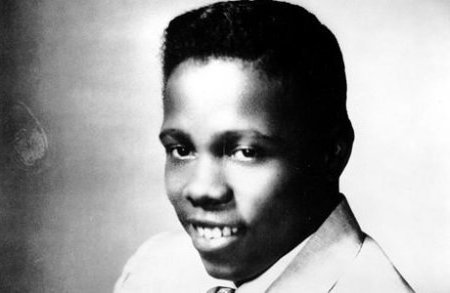 Johnny Ace (John Alexander) signed with Duke Records in 1952
as one of its original artists. Duke was owned by a principal of Memphis radio
station, WDIA. Unable to fund an
expanding roster and support a hit record, Duke was acquired by Peacock Records
of Houston, owned by Don Robey. Robey, according to Jerry Leiber (of
Leiber/Stoler fame) was a 5th Ward gangster who used threats and
intimidation to expand his empire. Really? In the music business? Robey is famously mentioned in the tune ‘Johnny
Ace Is Dead’ by Dave Alvin: “Slick Don Robey, the record company man, had big
diamond rings on both his hands. ‘I’m gonna take him back to Memphis in a
refrigerated truck. ‘Cause Johnny Ace is gonna make me a million bucks.’”
Johnny Ace (John Alexander) signed with Duke Records in 1952
as one of its original artists. Duke was owned by a principal of Memphis radio
station, WDIA. Unable to fund an
expanding roster and support a hit record, Duke was acquired by Peacock Records
of Houston, owned by Don Robey. Robey, according to Jerry Leiber (of
Leiber/Stoler fame) was a 5th Ward gangster who used threats and
intimidation to expand his empire. Really? In the music business? Robey is famously mentioned in the tune ‘Johnny
Ace Is Dead’ by Dave Alvin: “Slick Don Robey, the record company man, had big
diamond rings on both his hands. ‘I’m gonna take him back to Memphis in a
refrigerated truck. ‘Cause Johnny Ace is gonna make me a million bucks.’”
The picture above was taken by Ernest Withers, Memphis street photographer and portraitist. Visiting his Beale St. studios in 1999, I saw a shot he’d taken of Johnny's car, a big white Caddy with 'Johnny Ace' painted on either side, framed by black musical notes. I asked him how much he wanted for it – he said $100. I wish I’d parted with the dough.
Johnny’s biggest hit occurred posthumously, ‘Pledging My
Love’ – later covered by Elvis, among others. Take a listen – simple, powerful, soulful.
Five thousand folks attended his funeral. Women sobbed. The white Caddy
followed the hearse. They laid him
to rest. The next year, Don Robey made his million bucks.
Saturday, June 8, 2013
Saturday, May 25, 2013
On the occasion of Duke Ellington's birthday
Early in my career, I was a middle agent in the
music business. As such, I bought and sold dates on national touring
attractions, selling primarily to the college market. One of my ‘clients’ was
Luther College in Decorah, IA. One day in the spring of 1973, I got a call from
the Director of Student Activities, “These kids want Duke Ellington or somebody
like him…” or somebody like him? No – we’ll get Duke. I called the Willard
Alexander Agency.
I booked the date and paid Duke a whopping $3500
(correct number of zeros). He brought a full 10 piece band. The contract rider
called for ten music stands. Music stands hold sheet music. Not something you
find in a rock ‘n roll rider. Production specifics were minimal. “Buyer to
provide adequate sound and lights.” Huh? Again, unheard of in other
riders. For $3500 the buyer got a giant in American music, ten ace
players, and the charm, class and courtesy that came with the whole package.
Wanting to meet an American legend, I drove down to Decorah to 'deliver' the show. The concert venue was the gym. The stage sat against one cinder block wall, under a raised basketball hoop. ‘Luther Vikings’ in blue and gold provided the backdrop, flanked by images of bearded barbarians in horned helmets. Bleachers lined both sides. Acoustically, it was horrible. Sound consisted to two bass bins, down left and right, with horns atop. Lights were two pop-up trees, eight cans each and one Troopette spot, holding a four gel boom. Effective throw was maybe 60 feet. Any touring band would take one look, and get back on the bus. Duke didn’t bat an eye.
The band loaded in. The road cases were filled with stickers. “Passed Customs – Melbourne”, “Passe Douane – Orley”, Hong Kong, Pago Pago (!), etc. Everyone was polite. Everyone carried a chart case. These cases were placed next to each chair and each chair sat in front of a music stand. I asked one of the horn players about the charts. “Everyone reads?” He looked at me like I was nuts. I could feel my face redden. Of course everyone could read. What was I thinking. Sensing my discomfort he said, “You never know what the old man’s gonna call. And you’ve got about 12 seconds to find the chart and get it up on the stand. If you’re late, he’ll say, ‘we’ll begin this tune as soon as Mr. so-and-so finds his place’”
God-awful production values, shitty venues, and low money. He’s Edward Kennedy Ellington, for the gods sake…why? I had a hard time processing that one. It wasn’t until Duke hit the stage and settled behind the piano that I got it. He turned to the audience (packed) and uttered his signature line. “Ladies and gentlemen, we DO love you dearly.” And he did. It showed. And then there was the music. No Billy Strayhorn in attendance (though he was acknowledged by Duke, more than once). Duke’s son, Mercer, carried Billy’s horn parts. Duke looked at his grey haired son from time to time, and beamed. I’ve seen the same exchange before. Allen Toussaint was a client of mine years later. His son, Reggie, played percussion in his father’s band. When Allen introduced the group mid set, he always said the same thing, “…and on percussion, my son Reggie, in whom I am well pleased.” When that moment came in Duke’s show, his line was, “…and my darling son, Mercer, on trumpet.” I don’t know if it was a regular thing. Mercer stood, and looked at his shoes.
Duke
pushed that band through its paces, very much in command. And there was a fair
amount of frantic shuffling through chart cases as sheets were shifted on the
stands. Duke would raise his hand, moving his wrist like a metronome, and a new
tune would kick off. The sense I got, watching from the bleachers, was that
Duke (and the band) were present. They were here, now. No matter how many times
they had done it before. The band played. Duke conducted. And they all did it because they HAD to. It
was what they did.
Mercer, aside
from being a trumpet player, was also road managing. After load-in, Duke,
through Mercer, asked to speak to the sound man. I dutifully produced him.
"You're doing sound?" Duke said to the guy. "Here's what I want.
Turn it up loud enough so you can hear it - then DON'T TOUCH IT." There
was NO sound check.
The gym
began to fill. Showtime was 8:00. The band was gathered in the hall by the door
closest to the stage (3 foot risers, typical college low tech). At 7:59 Duke
appeared. "Places, gentlemen!" Talking stopped, everyone lined up.
"Take the stage."
The audience was a mixture of callow students, fresh faced Scandinavian kids, most of whom didn’t have a clue as to what they were witnessing, and middle aged rural Iowans. John Deere hats had been left at home and the tell-tale white forehead above the brim line spoke of years atop a tractor. Flower prints seemed favored by the women. There was an eagerness to them as they filed in and settled in the bleachers. The show did not disappoint.
After the show, Mercer asked if I'd like to meet his father and be properly introduced. Wood eye, wood eye?! You betcha. The 'dressing room' was the boy's locker room. We walked in. There was one light on in the front of the room and the faint odor of athletic perspiration filled the space. Duke, sitting in the shadows, was resting in a chair next to a row of lockers. He had a doo-rag on his head, he was nude from the waist up. His eyes were closed. "Papa...Papa?", Mercer whispered. Duke looked up. "Papa, there's someone I want you to meet." I felt about 20 feet tall. I'll never forget it.
Sitting in the dim light of the locker room, Duke and I spoke briefly. He wanted to know about Luther College. Was it a religious school? He had just written an oratorio for a mass and wondered if the school might be interested in such a thing. Looking back, he probably thought I was with the college. No matter. I was sitting on a bench in front of some lockers where, five hours earlier that day, someone had sat surrounded by the boisterous noise of towels snapping, lockers slamming. Now it was quiet. And I was talking with Duke Ellington.
Subscribe to:
Posts (Atom)